Book Review
Mastering Behavioral Interviews by Austen McDonald
McDonald's book guides product development professionals of all disciplines and experience levels to craft, deliver, and own their narratives, upleveling how they communicate to future peers and leaders.
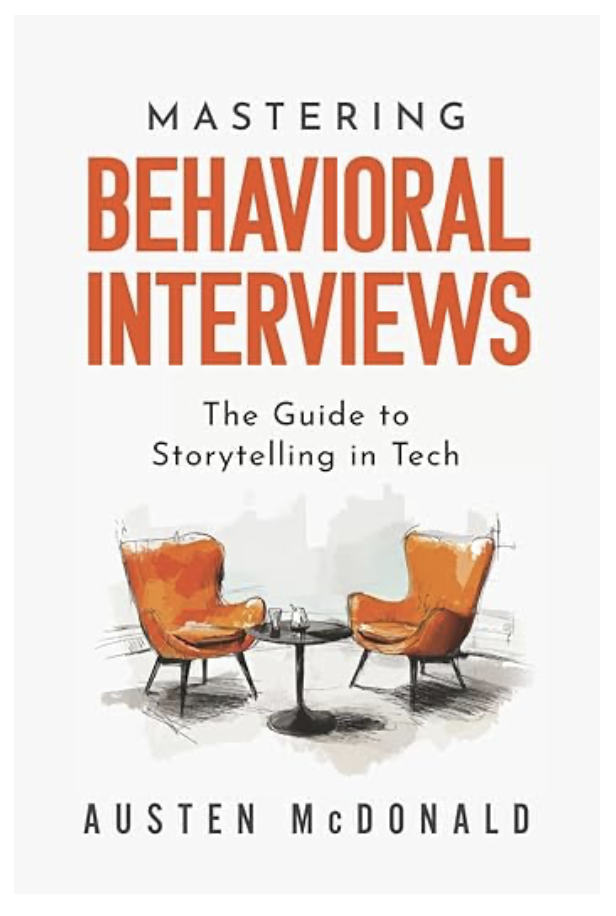
Mastering Behavioral Interviews stands out in a crowded field of LinkedIn advice, YouTube videos, and other books by treating interviewing not as a memorization exercise, but as a discipline of intentional communication. Rather than coaching readers to “game” behavioral questions, the book focuses on helping candidates clearly articulate how they think, act, learn, and create impact—exactly what interviewers are actually trying to assess.
For transparency: Austen and I worked together at Meta—he as an engineering leader and I as a design manager supporting his teams—and he shared an advance copy of his book for review.
While written for an engineering audience, it’s not a stretch to abstract his clear, practical point of view beyond engineering and apply it to those in product design, product management, or even other adjacent roles (such as data scientists, product marketing managers, ux researchers, and content strategists) who are interested in leveling up how they communicate the nuances of their work.
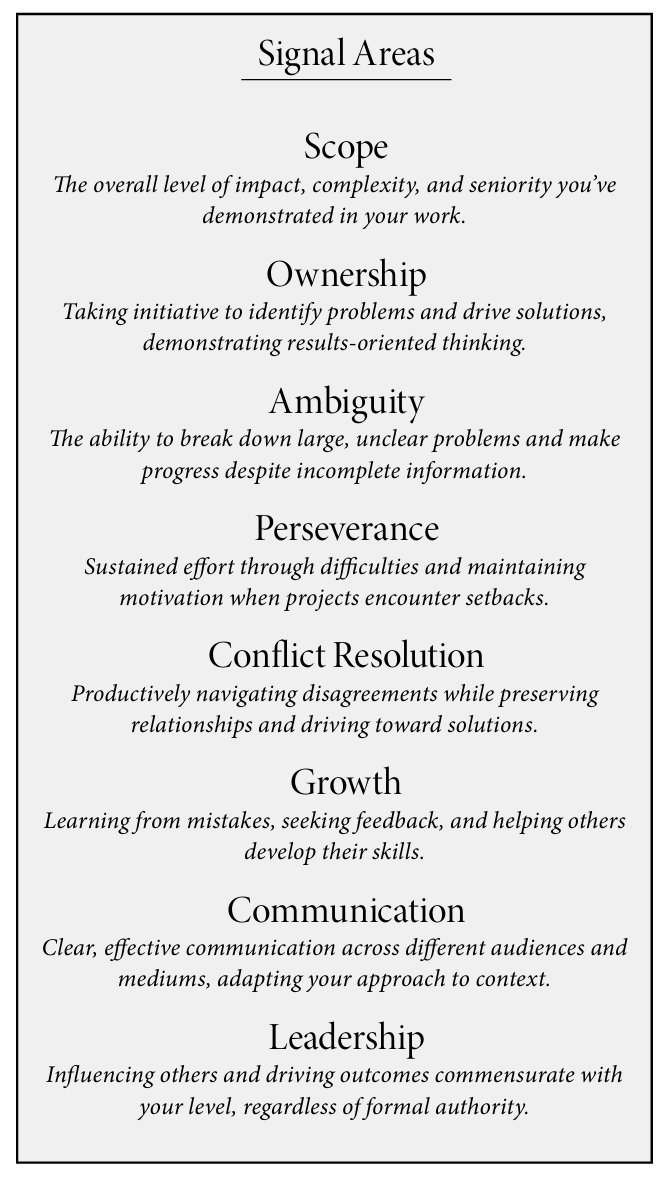
The lessons in communicating impact, scope, complexity and ambiguity, and navigating conflict and success span far beyond simple job titles or reporting lines. In fact, McDonald’s book would help any organization or functional leader reflect on how they are leveling their teams, reviewing performance, and hiring & promoting people as they read the sample scenarios, prompts, and responses.
One of the book’s strongest contributions is its clear preference for the CARL framework (Context, Actions, Results, Learnings) over the more commonly cited (and Amazon’s preferred) STAR method. While Situation, Task, Action, Result is familiar, the book makes a compelling case that it often falls short—especially for more senior candidates—because it omits reflection. CARL’s explicit inclusion of Learnings gives interviewers signal on judgment, growth, and scope, not just execution.
McDonald also cites that less experienced interviewees frequently risk commingling tasks and actions when relying on the STAR framework, muddling the interview. By focusing on CARL instead, the result is storytelling that feels more mature, intentional, and aligned with how experienced interviewers evaluate candidates.
More broadly, the book reinforces the idea that communicating through frameworks signals intentionality. Responses structured around CARL aren’t just easier to follow—they demonstrate how a candidate organizes complexity, prioritizes information, and reflects on outcomes. That meta-signal alone is incredibly valuable, especially in senior or leadership interviews where clarity of thinking matters as much as the story itself.
Both people who are actively interviewing for a new role and those who are content in their current positions will benefit from McDonald’s advice reflecting on how they can use frameworks to consistently break down a problem at several altitudes and points of view, whether they’re in an interview or leading a kickoff meeting.
A standout concept is the Story Catalog. While framed as interview prep, it’s arguably one of the book’s most broadly useful ideas. Building a structured catalog of career stories—complete with context, actions, outcomes, and learnings—is valuable not just for interviews, but for performance reviews, promotion packets, and self-reflection. Even for those not actively job hunting, the process helps build self-awareness and narrative fluency around one’s own impact.
The Pitfalls section is another highlight. Organized by signal area, it functions as a practical checklist for self-editing stories: what you’re over-emphasizing, what you might be under-selling, and where ambiguity or lack of ownership could raise red flags. It’s especially helpful for experienced candidates who assume their stories “speak for themselves” but may be missing key evaluative signals.
Finally, the chapter on adapting responses for Big Tech (notably around page 224) is both concrete and nuanced. Rather than encouraging candidates to cosplay scale they haven’t experienced, it focuses on reframing language, impact, and decision-making in ways that align with Big Tech expectations—systems thinking, data-driven framing, ownership, and cross-functional influence.
This advice alone makes me almost want to re-interview at Meta as I had little clue what I was doing in the interview process back in early 2020. I just answered the interviewer panel’s questions with little intentionality (even though I was still effective enough, obviously). If I only knew then what I know now, as the swan song goes.
Overall, Mastering Behavioral Interviews succeeds because it treats interviews as a communication craft, not a performance trick. It’s useful for early-career candidates, invaluable for senior leaders, and surprisingly effective as a tool for reflection even outside the job search.